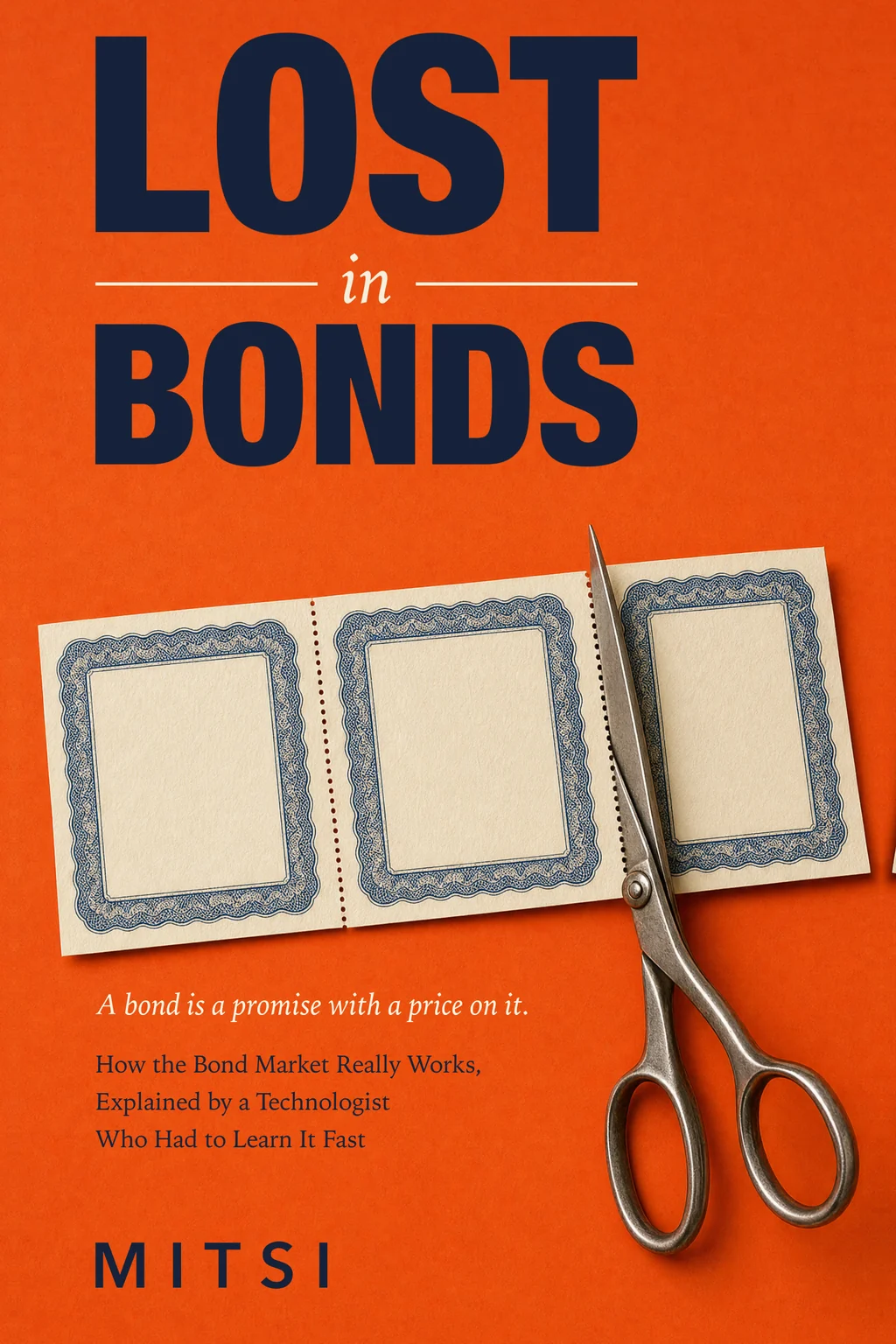
Lost in Bonds

How the Bond Market Really Works, Explained by a Technologist Who Had to Learn It Fast

Mitsi

A bond is a promise with a price on it.

Sydney, 2023.

$160.7 trillion.

The biggest market nobody explains.

Global bonds outstanding at the end of 2025. Source: SIFMA Capital Markets Fact Book 2026.

Five people, two desks,

one bug that wasn’t a bug.

Out January 1, 2027

Join the waitlist

The cover of Lost in Bonds by Mitsi: navy title lettering on orange paper, a strip of three bond coupons and a pair of scissors cutting between them.

The book

Bonds don’t have a ticker, an exchange or a single price.

A new CTO found that out while building the software to trade them.

In early 2023 Mitsi became chief technology officer of a small fintech startup in Sydney that was building software for pricing and trading bonds. Mitsi had never priced a bond. The first serious bug took two days to chase, and it wasn’t a bug: the screen was showing a “dirty” price, with accrued interest folded in.

One colleague, who appears in the book as Rhys, was a bond salesman who thought in yields. His lesson runs through the book: a bond is a promise with a price on it, and the job is working out what that promise is worth today.

Lost in Bonds is the guide Mitsi wanted in 2023. It explains:

  • why bond prices fall when rates rise, and how the benchmark US bond index lost 13% in 2022
  • yields, duration and the yield curve, with worked examples you can check
  • how a deal gets priced, using Apple’s $17 billion bond sale of 2013
  • how bonds trade without a central exchange
  • what happens when promises break, from Detroit and Lehman Brothers to Silicon Valley Bank
  • how US Treasuries and Australian Government Bonds are sold

It’s written for engineers, founders, professionals and investors who want to understand the market under their mortgage rate, their pension or super fund and the evening news. Every figure is sourced, and nothing in it tells you what to buy.

Prologue, February 2023

The bug that wasn’t

Our bond prices came out a little higher than the ones in Rhys’s notebook, and the gap grew every day. Plotted against the calendar, it looked like a saw blade. “Our price was dirty,” he said.

46

A $100 bond paying a 5% coupon twice a year: $2.50 every six months. Day count 30/360, so every month counts as 30 days and each coupon period as 180.

Clean price 98.7500 What the market quotes. Held fixed here.
Accrued interest 0.6389 $2.50 × 46 / 180, the seller’s share of the next coupon.
Dirty price 99.3889 What the buyer actually pays at settlement.
Accrued interest over one year Accrued interest on the bond climbs in a straight line from $0 to $2.50 over each 180-day coupon period, then drops to zero when the coupon is paid, which draws a saw blade with two teeth a year.
$63,888.89 of accrued interest the buyer would hand over on $10 million of these bonds, on top of the clean price. The chart is per $100 of face value.

What’s inside

Four parts, sixteen chapters

With a prologue, three interludes back in the Sydney office, a conclusion and an epilogue.

  1. Prologue The dirty price
  2. Before we start A note before we start
  3. Part One

    The promise

    1. 1 The $160 trillion market nobody understands
    2. 2 The infinite varieties of IOUs
    3. 3 The mathematics of future cash
    4. 4 Credit ratings: the trillion-dollar opinion
  4. Interlude Three in the morning
  5. Part Two

    How a bond is born

    1. 5 The decision to borrow
    2. 6 The deal team
    3. 7 The roadshow and the order book
    4. 8 The fine print
    5. 9 Pricing day
  6. Interlude The notebook beside the screen
  7. Part Three

    Life after issue

    1. 10 The market that never sleeps
    2. 11 When promises break
    3. 12 The watchdogs
    4. 13 The exotic zoo
  8. Interlude The safest bonds in the world
  9. Part Four

    Three stories

    1. 14 Apple, ten years on
    2. 15 Lehman Brothers: anatomy of a collapse
    3. 16 The deepest market on earth: US Treasuries
  10. Conclusion Why bonds will always matter
  11. Epilogue What the promise is worth
  12. And Glossary, further reading, acknowledgments

From the prologue

The dirty price

Two days on one number

In February 2023, at the sticky end of a Sydney summer, the other engineer and I spent two days trying to find out why our bond prices were wrong.

They were only slightly wrong, which made it harder. We had built a pricing screen, the first piece of our software that looked like something a client might one day pay for, and for almost every bond on it our price came out a little higher than the price Rhys had written in his notebook. Sometimes the gap was a few cents per 100 dollars of face value. Sometimes it was more than a dollar. It was never the same two days in a row.

We worked from a couple of desks in a shared office in the city. The startup was building software to price, distribute and trade bonds electronically for institutional investors in Australia and Asia. I had joined a few weeks earlier as chief technology officer, a title that in a company of five meant writing a lot of the code and descaling the kettle. The building’s air conditioning went off at six. By seven the humidity had found its way back in, and we were still there.

We did what engineers do with a bug. We assumed it was ours and went looking in the usual places. Floating-point rounding came first, because it is always the first suspect and hardly ever guilty.

The prologue continues in the book.

About the author

Mitsi

Mitsi is a technologist who has spent a career building trading systems. In 2023 Mitsi became CTO of a small Sydney fintech startup that built software for pricing and trading bonds, and found that knowing how a matching engine works is no preparation at all for knowing what a bond is worth.

Lost in Bonds is the book Mitsi wishes someone had handed over on the first day. Mitsi lives in Sydney and still builds trading systems.

Out January 1, 2027

Hear when the book is out

Leave your email address and you’ll hear when Lost in Bonds is published.